Learn it. Then prove you
actually understand it.

A short talk about how learning works —
and a small open-source tool built around it.

I · how learning works

Rereading feels like learning.
It mostly isn’t.

Read a chapter twice and it feels familiar. But familiarity is recognition — the ability to nod along. Understanding shows up as recall: producing the idea yourself, with the book closed.

Psychologists call the gap the illusion of fluency: rereading and highlighting rate high on effort and low on effect.

I · how learning works

What works: retrieval.

Trying to pull something out of memory strengthens it more than putting it in again. Let’s do one:

flip card

What is the capital of Australia?

Canberra — not Sydney, not Melbourne.
That small struggle you just felt? That is the rehearsal that makes memory stick — the testing effect.

I · how learning works

…and spacing.

Memory decays on a curve. Each successful recall, made just before you’d forget, flattens it — so the reviews get rarer while the memory gets stronger.

review 1 review 2 review 3 retention without review

That schedule is mechanical — exactly what software is for. Spaced-repetition systems have run it since the 1970s.

I · how learning works

The new trap: AI answers feel like understanding.

A large randomized trial gave ~1,000 students GPT-4 for math practice. While the AI was there, practice went great. Then came an exam without it:

−17 %

— worse than students who never had AI at all. A guardrailed tutor that wouldn’t just hand over solutions eliminated the harm. But it added no gain.

Bastani et al., “Generative AI Can Harm Learning”, PNAS 2025. Randomized controlled trial, ~1,000 high-school students.

Don’t use AI to get answers.
Use it to check you understand.

II · alix

alix — a plain-text trainer that takes this seriously.

Spaced repetition at the core, an AI layer woven through — a tutor on any card, generated decks, and an exam that gates progress on verified understanding. In your browser — an adult view, or a simpler one for kids. Local-first. Open source.
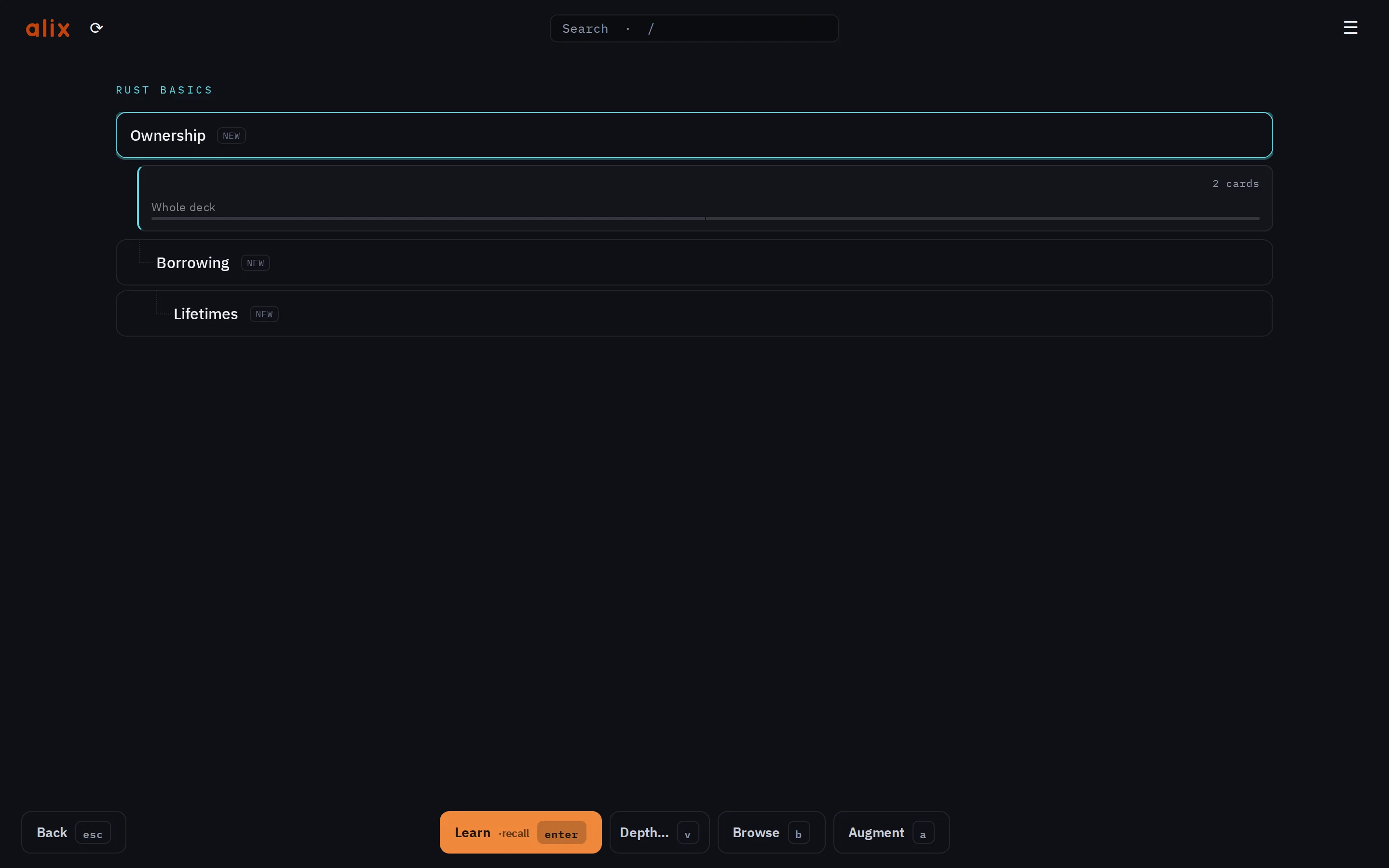
the alix picker drilled into a workspace: its decks as a dependency tree
the picker — a workspace’s decks in prerequisite order

II · alix

Your cards are plain text you own.

## What does the CAP theorem state? <!-- reveal: line -->
A distributed store can guarantee only two of:
Consistency, Availability, Partition tolerance.
> The trade-off only bites while a partition is happening.

A deck is a file. Write it in any editor, version it with git, grep it, keep it for decades. No account, no database, no lock-in — and one comment-style directive can change how a card quizzes you.

II · alix

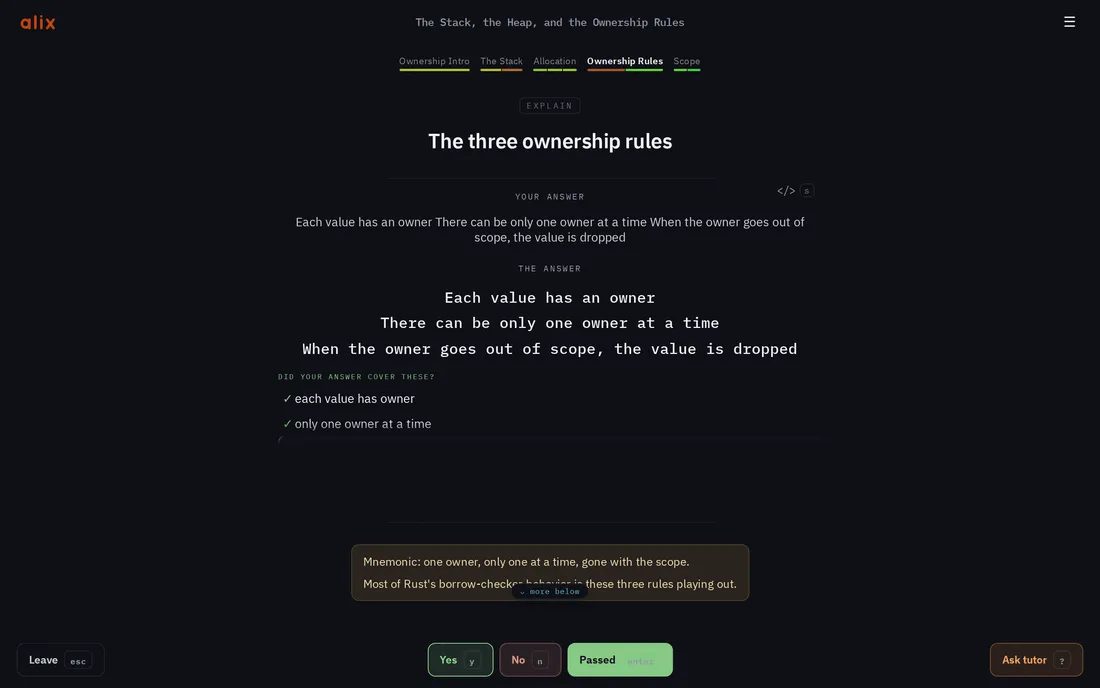
Review, the classical part — done properly.

an explain card revealed, its note shown, key points checked to grade it
a revealed card in the web frontend

II · alix

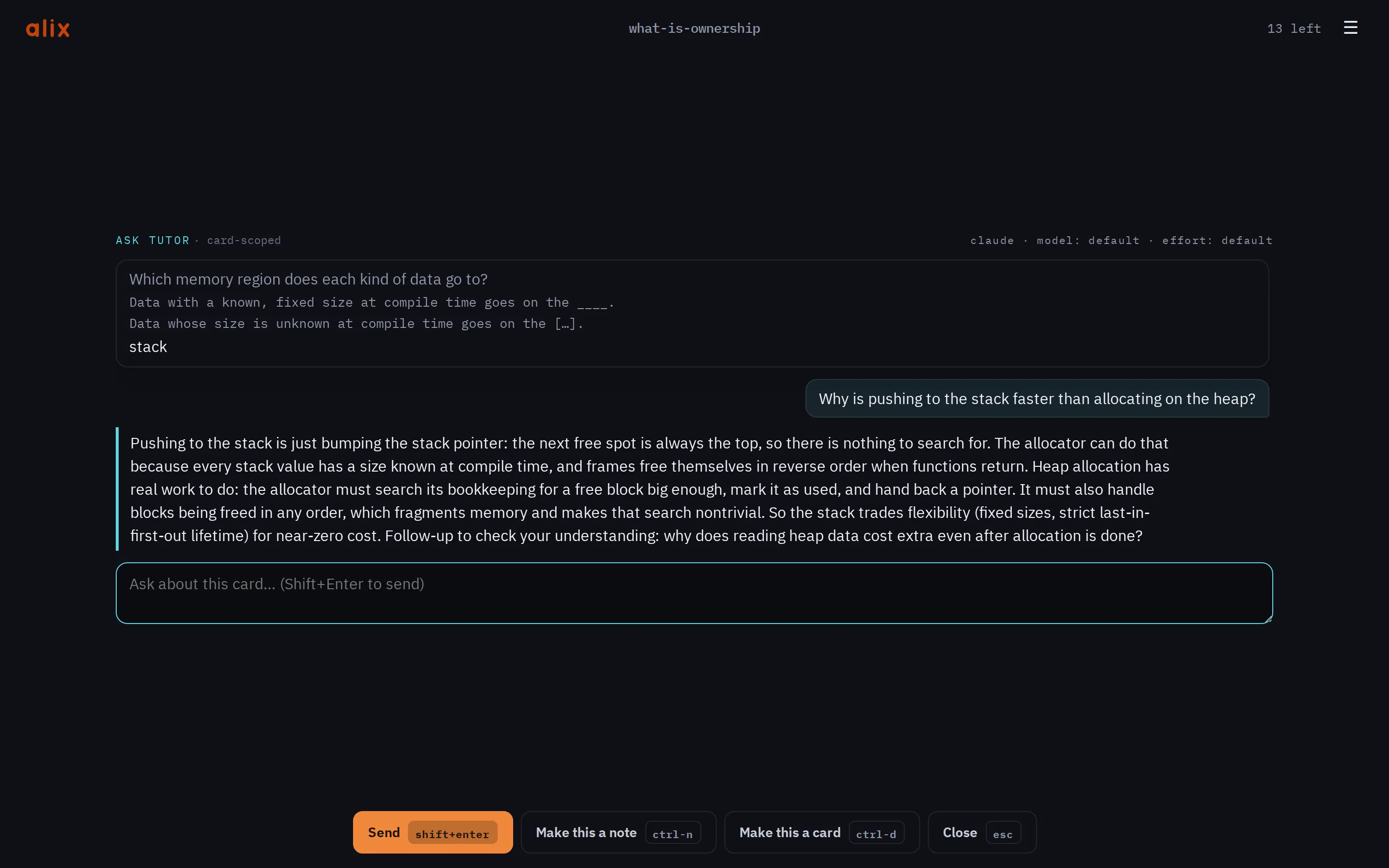
Stuck on a card? Ask.

One keypress opens a tutor on the card you’re looking at — grounded in the card, its deck, and (if you allow it) the deck’s actual source. Good explanations can be saved back onto the card as a note.

the ask panel answering a question about the current card
the tutor stays inside the session — context comes along for free

II · alix

Drilling proves recall.
The exam checks understanding.

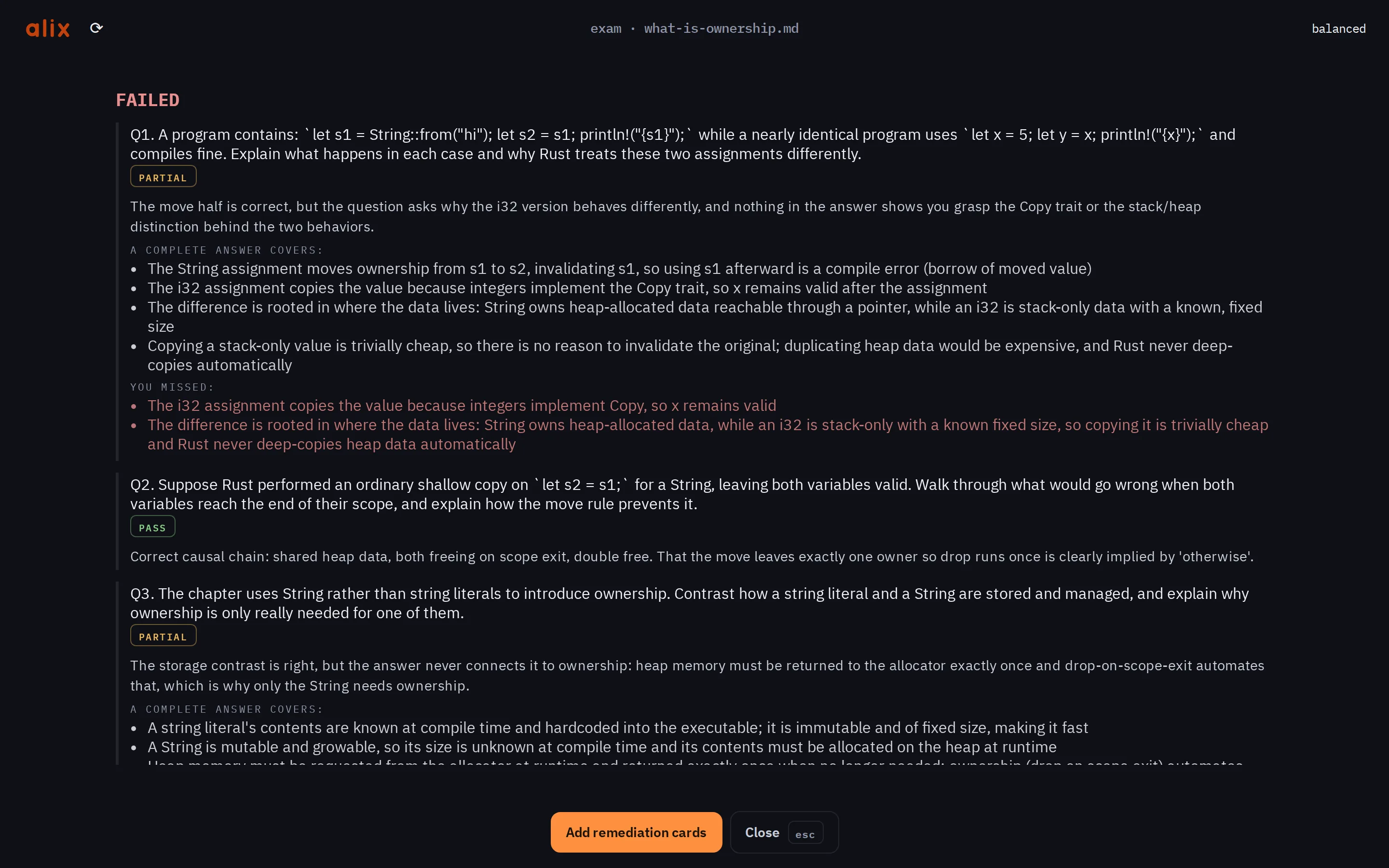
A deck can name its source — a chapter, a paper, real code. Once the cards are drilled, the AI writes fresh open questions from that source and grades your written answers against it — never against your cards. Pass, and the topics that build on this one unlock.

the exam grading typed answers against the deck’s source, with a remediation-cards action
mastery — not mere drilling — unlocks what depends on it

II · alix

Traces — drill the edges, not just the facts.

Cards hold the nodes of what you know. A trace walks a real path through a source — every step you predict what happens next, then the actual lines are revealed, and you judge your gap.

II · alix

Start from your material.

III · honestly

What alix is not — on purpose.

  • Not an answer machine — it won’t do tonight’s homework.
  • Not a chat wrapper — the AI never floats free of a card, a deck, a source.
  • Not gamified — no streaks, no XP, no leaderboards.
  • Not a cloud service — no accounts, nothing to sync, nothing that can shut down and take your decks with it.
  • Not a content marketplace — you bring or generate the material from your sources.

Every refusal buys the one thing it is:

verified understanding,
on a schedule,
in files you own.

III · honestly

What you should know before trying it.

III · honestly

Where it sits.

flashcard apps

  • retrieval + spacing, proven
  • recall of isolated facts
  • no check that ideas connected

AI chat tutors

  • explain anything, instantly
  • no schedule, no retention
  • answers on tap — the −17 % trap

alix tries the intersection

  • plain text, local, yours
  • spaced retrieval for memory
  • AI that verifies, not answers

Each neighbor does its own job well. The combination is the empty spot alix aims at — whether it fills it well is for you to judge.

III · honestly

Try it in five minutes.

$ curl -sSf https://alix.study/install.sh | sh
alix generate <lecture-url>turn something you must learn into a deck
alixreview it — the deck picker opens in your browser
alix → Examwhen it’s drilled: prove you understood it — one click in the picker

Binaries for Linux, macOS, Windows — or cargo install alix. MIT/Apache-2.0, source on GitHub.

These slides are one file.
Make them yours.

alix.study · github.com/Alex6323/alix · the book: alix.study/book
Slides: alix.study/slides.html — MIT/Apache-2.0, adapt freely. Appendix follows for the curious.

A · appendix — the deck format on one slide

## frontstarts a card; the plain lines below are the answer
\blank{span}cloze — each blanked span in the answer becomes its own sub-card
- [x] / - [ ]a task-list answer is an authored multiple-choice card
> noteshown after answering
<!-- reveal: line -->flip · line — how a card presents; how deeply you drill is a per-session choice
direction: bothreview a card in both directions (frontmatter or per card)
requires: <deck>frontmatter prerequisite — builds the unlock tree
source: <url|path>frontmatter: the exam’s ground truth (and the tutor’s reference)
<!-- at: file:lines fingerprint: xxh64-… -->a citation — the card can reveal its source lines

The full reference lives in the book.

A · appendix — the exam, precisely

A · appendix — one checkpoint of a real trace

---
trace: how pressing the Good key becomes a saved grade
source: ..
---

## You press Good. What does the page send the server — and what not?
grade(g) POSTs /api/grade with { grade: g } and the session revision
echoed in a header — no card id; the server owns the seat.
<!-- at: web/alix/review/study.js:100 fingerprint: xxh64-9f21c07d3ab54e68 -->
> The page is a thin view; the server owns the session.

You answer the question before the cited lines are revealed — then judge your own gap. The next checkpoint picks up exactly where this one left off.

A · appendix — references

A · appendix — likely questions

Does my data leave my machine?No — decks and progress are local files. Only the AI calls you make go out, through your own CLI account.
Which AI do I need?Any one of: Claude Code (default), Gemini CLI, Codex CLI, Copilot CLI — signed in. Codex can’t fetch URLs; use local sources there.
Does it work offline?The whole flashcard core, yes. AI features need the network.
What does it cost?alix is free and open source. The AI backend uses a subscription you likely already have.
Can I import from Anki?Cards, yes (TSV export) — scheduling history, no.
→ advance · n notes · o contents

speaker notes

contents — click to jump, o or Esc to close